
What Is A Sales Playbook?
A sales playbook is a management tool for getting sales, product, pricing, and marketing managers on the same page. It helps them define, organize, centralize, and disseminate five categories of information and content:
- What to Know. What are we selling? Who are we selling to? What problems are we solving
- What to Say. Including conversation tracks, messages, questions, and stories.
- What to Show. Including sales presentations, videos, handouts, comparisons, etc.
- What to Do. Including best practices i.e. selling skills, procedures, policies.
- What to Measure. To ensure that revenue and profitability goals are being met.
But what does a sales playbook do for salespeople? Why do salespeople not use their sales playbook?
Sales Playbooks Force Salespeople To Stop Selling
Unfortunately, sales playbooks cause salespeople to stop selling to spend time searching, reading, memorizing and remembering information. Salespeople are paid to execute sales conversations with buyers, generate opportunities and close deals. Anything that distracts salespeople from selling is met with skepticism.
But to grow revenue with precision - - effectively, efficiently and preditably - - sales management needs:
- New salespeople and partners to learn offerings, customers, competitors, your sales approach, procedures, and other information.
- Existing salespeople to stay current with changes to offerings, new product launches and continuously update their sales approach.
- Poor performing salespeople to re-learn information and content and update their sales approach.
So, how is sales management supposed to accomplish this without forcing sales people to stop selling?
Is A Sales Playbook The Right Solution Be Used To Solve The Wrong Problem?
Is the lack of organized information in a static sales playbook the cause of poor execution from sales conversation-to-sales conversation and salesperson-to-salesperson? Or is the problem rooted in the inability of your salespeople to apply volumes of everchanging technical information and selling skills "live time" during sales conversations? Unfortunately a sales playbook does nothing to help salespeople with:
- Getting and keeping the buyer on the same page throughout all stages of the sales conversation.
- Validating assumptions about what problems buyers want to discuss and solve, what they know and don't know about their situation, and if they have a framework for assessing competing solutions.
- Sequencing and accurately presenting the right questions and answer options at the right time to understand the buyer's situation, define and prioritize buyer problems, clarify the impact the problems are having; establish an economic reason for solving the problem.
- Answering questions about products, services, applications, and competitors that buyers know to ask and those they don't know to ask.
- Accessing and sharing information including demonstrations and comparisons, pricing and discounts, case studies and testimonials, product and service information sheets.
- Presenting proposals including preparing recommendation options, pricing, and discounts, terms, and conditions.
- Testing buyers at each stage of the exchange of information for understanding and agreement.
- Switching roles between talking, viewing and listening; interpreting and preparing responses; searching for information and documents.
- Mitigating differences with buyers including frames of reference and assumptions, language and terminology, knowledge and experience, the timing of decisions, personal agendas and priorities, personality styles.
- Remembering to apply selling skills and methods, company policies and procedures, best practices, legal compliance measures.
So, what would happen if we shifted our focus to equipping salespeople to apply technical knowledge and selling skills "live time" during sales conversations - - without causing them to stop selling?
Learning Technical Knowledge Forces Salespeople To Stop Selling
Time is spent:
- Reading documents, reviewing website pages, and watching videos.
- Taking and organizing notes on what they were learning.
- Studying and memorizing that information.
- Meeting with technical experts to ask questions.
- Attending training classes led by technical experts.
- Completing self-paced eLearning programs.
Information included:
- Products and services.
- Applications of the products and services.
- Pricing, discounts, contract terms and conditions.
- Value propositions and unique differentiation.
- Competitors and their vulnerabilities.
- Customers industries and their customers.
Planning Sales Conversations Forces Salespeople To Stop Selling
Time is spent:
- Studying and memorizing sales playbooks, FAQ’s, and scripts.
- Listening to recordings of sales conversations.
- Participating in field sales meetings to learn from other salespeople.
- Crafting sticky notes, checklists, and scripts to help them remember.
- Creating their own sales conversation decision tree.
- Preparing presentations and handouts
- Rehearsing their sales approach and mock sales conversations.
Information included:
- Questions to understand buyers situation, problems, impact, and payoff.
- Explanations to demonstrate offerings, features, functions, and benefits.
- Formulas and calculations to create the right pricing and proposals.
- Negotiating points, terms, and conditions to close deals.
- Objection handling tactics across all steps of the sales conversation.
- Market knowledge i.e. industry, company, department, process, etc.
- Competitor knowledge i.e. offerings, differentiation, comparison points.
Equip Salespeople To Keep Selling While Applying Technical Knowledge and Selling Skills
What would happen if you stopped requiring your salespeople to stop selling to:
- Learn company offerings and information without reading, studying, attending meetings, memorizing and taking notes?
- Craft their sales conversation approach including sequences of questions, answer options, explanations, formulas, etc.?
- Study updates to new products, features, pricing, discounts, competitor information, customer industry information, etc.?
- Figure out how to integrate those updates to their sales approach?
- Get answers to buyer questions and find information to send buyers?
What if you focused on equipping salespeople to navigate the exchange of information between the buyer and seller that:
- Keeps salespeople selling rather than stopping to search for, read, memorize, and remember.
- Delivers the right information at the right time during sales conversations.
- Shows them how to execute the ten tasks above with precision - - effectively, efficiently, and predictably.
- Instantly and accurately applies knowledge and skills.
- Prevent the need to stop sales conversations to find information and disrupt managers and experts for answers.
How would this impact sales effectiveness, efficiency and predictability?
The Impact Of Equipping Salespeople To Navigate Sales Conversation Complexities
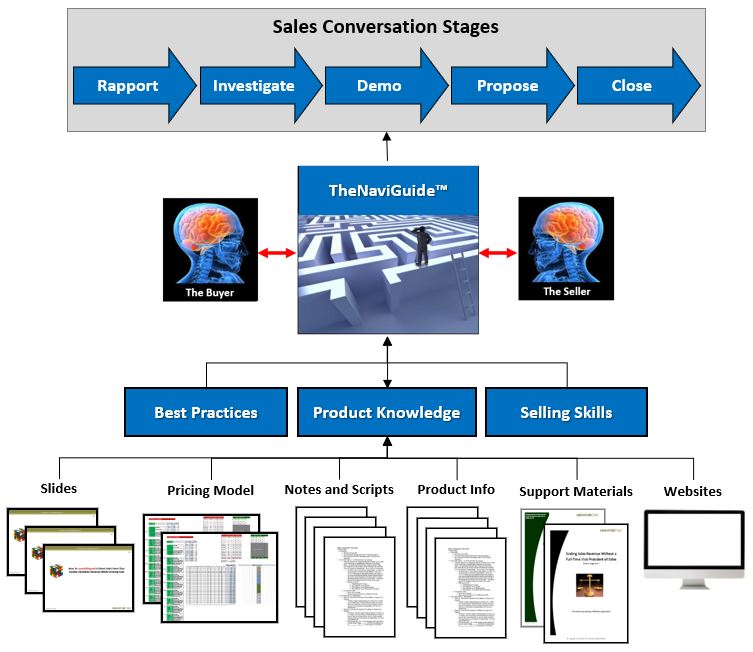
We found that converting a sales playbook into a procedure tool increased adoption by salespeople. More specifically, we experienced positive results in four areas. First, TheNaviGuide nearly eliminated the need for new salespeople to spend time: 1) learning sales procedures, 2) preparing reminders for executing sales procedures, and 3) searching for instructions and information.
Second, TheNaviGuide reduced the time that sales managers and technical experts spent with new salespeople: 1) training, 2) handling complaints, 3) correcting mistakes, 4) re-explaining information, and 5) answering their frequent questions.
Third, we found that new salespeople used TheNaviGuide as a reference tool when executing sales conversations.
In short, TheNaviGuide converted a sales playbook from a management tool into a selling tool. It equips salespeople keep selling while applying technical knowledge and selling skills live-time during conversations.
Click Here to learn more about TheNaviGuide and how to implement it